
Guide

FE farming
How to count what a farm really makes (net, after tax, per real hour), what players’ SS14 runs show, and what is known about the Trade House tax.
Run an affordable farming experiment ↓
Also called: Flame Elementium
Flame Elementium, FE per hour, farming strategy, Trade House tax, how to make FE
Last checked against SS14 Tartarus · 7 min read · updated
In TLI Toolkit: FE tracker: net per map and per hour, after tax
On this page
Which setup should you test first?
In the November 10 SS14 snapshot, 11 compass-free Deep Space maps had a median net of +30 FE. The larger tier-9 group without a recorded drop Pactspirit had 90 maps and a median of −53 FE. If entry costs strain your budget, test a cheaper setup first. The groups differ in more than compass use, so these medians cannot isolate the effect of removing a compass.
Currency and entry items to price · Flame Elementium · Deep Space Beacon · Consultation Vorax Compass


Run an affordable farming experiment
Your goal is a repeatable result after costs, not a large loot screenshot. Start with a setup you already clear safely, enough currency to replace its inputs, and a tracker running before the first map opens. Choose a loss limit and a batch size before buying supplies. Fifty maps is a suggested comparison batch, not a guarantee of accuracy or a public-data admission rule.
Record the exact setup: region, difficulty, compasses, probes, added modifiers, Pactspirits and Void Chart. Price the inputs you will actually consume. Keep a reserve outside the experiment; stop buying maps when the next opening would cross your loss limit. If the setup is unaffordable, remove an optional input or test a familiar lower difficulty first.
Run the same setup for the planned batch. Count mapping, town, selling and associated minigames in the same time boundary. Record unspent entry tokens separately; they are future opportunities, not already realized rewards. Change one setup variable for the next batch so you can identify what changed.
Reconcile the worked example below, prepared on 2026-11-15: 30 × 89 = 2,670 FE spent; 3,000 FE loot value; 2,000 FE sold, paying 250 FE tax; 1,000 FE still held. Valued profit is 80 FE, or 53.3 FE per real hour over 1.5 hours. Cash received is 1,750 FE, so cash after entry costs is −920 FE plus the unsold stock. The 80 FE is not cash already earned, and this example predicts no farming rate.
The short answer
A farm earns only after entry costs, sale tax and all active time are counted. Start with your own affordable experiment. The tables below preserve a November 10, 2026 snapshot of 284 shared runs from four players; they describe that historical sample, not the whole season or your future earnings.
Count it the honest way
- Net, not gross.Drops at the price you can sell for, minus everything the map device took.
- After tax.The Trade House keeps 12.5% of each item sale. See the worked example.
- Per real hour.Town time, selling and the minigames count. For a positive profit, counting map time alone raises the quoted rate.
- Over many maps.One jackpot makes a session; judge by the median map over 50 or more, with the jackpots apart.
The same session, counted both ways (a made-up example; every number is shown):
Historical measurements and price inputs
| FE | Hours | FE per hour | |
|---|---|---|---|
| Gross, in the map (what a title says) | 3,000 | 1.0 | 3,000 |
| − map costs | −2,670 | ||
| − tax on what was sold | −250 | ||
| Net, real time | +80 | 1.5 | +53 |
What players’ runs show this season
From the 284 runs 4 players shared by 2026-11-10. Net after each run’s own costs and the tax; the median is the run in the middle.
Historical measurements and price inputs
| Runs (players) | Median net, FE | Middle half, FE | In profit | Minutes | Confidence | |
|---|---|---|---|---|---|---|
| Deep Space map, tier 9 (no Pactspirit recorded) | 90 (3) | −53 | −81 to −17 | 21% | 2.0 | medium |
| Deep Space map without compasses | 11 (3) | +30 | +15 to +58 | 91% | 1.3 | low |
| Vorax run (Surgical Preparation) | 21 (3) | +332 | +118 to +647 | 100% | 1.7 | low |
| Tartarus Prison run | 21 (4) | +259 | +143 to +455 | 100% | 1.1 | low |
The tier-9 row is the 90 of the 104 shared tier-9 maps that came without a drop Pactspirit recorded: the tables group maps by Pactspirit, and this is their largest group.
- In the November 10 sample, the maps supplied the 12 tokens for a Vorax or Tartarus entry, so the minigame rows leave that entry cost with the maps. The Deep Space guide illustrates allocating rewards back to maps by adding medians from distinct map and minigame samples. That sum is not a measured median or evidence of profitability for a complete loop; measure the rewards, costs and time of your own whole loop.
- Four players is a small sample: treat these as a dated case, not a ranking. Current publications can also be withheld when their checks fail.
Where FE comes from
| Source | How it pays | What to watch |
|---|---|---|
| FE on the ground | Straight into your bag, no tax | The only income that needs no selling |
| Items you sell | At the Trade House price, minus the tax | Price the day you sell; thin markets drop when you list many |
| Minigames (Vorax, Tartarus, the Void Sea …) | Their own rewards, paid for by tokens or items from maps | Count them with the maps that fed them |
| Jackpots (Hero Memories, rare gear) | Rarely, and a lot | A Memory of Progress lists near 2,500 FE; keep them out of your “usual map” |
| Crafting and gambles | Can pay, can burn FE | Do the math first: the app’s calculators |
The Trade House tax
The Trade House keeps 12.5% of each item sale. Sell an item for 80 FE and 10 FE goes to tax, leaving you with 70 FE. Pick up 80 FE directly and you keep all 80.
In TLI Toolkit, open Settings → Farming. Turn on Values after tax to value item drops at their sale proceeds. Turn it off to see their full price. FE you pick up has the same value either way.
Choosing a farm: a checklist
- Start from what you can clear fast and safely. A map you die in or clear slowly costs the same as a fast one.
- Price your map before you run it: beacon, each compass and probe, and the Resonance (six modifiers cost 63, about 6 FE). See the Resonance guide.
- Run 50 maps the same way, then look at the median and the FE per real hour.
- Change one thing at a time (a compass, a Pactspirit, a region) and run another 50.
- Play the minigames your maps pay for (the Vorax and Tartarus guides), and count them with the maps.
- Take ideas from the shared setups on the strategies page, then check them on your own maps.
- Set your Drop Filter for the strategy: the loot filter recipes list what to keep above a price you choose.
Common mistakes
- Quoting FE per hour in the map only. Town, selling and minigames are real time too.
- Pricing drops at the highest listing. Sell price is what someone pays, after the tax.
- Counting a Hero Memory jackpot as the farm’s usual income.
- Comparing two farms over ten maps each. The spread between maps is larger than most differences between setups.
- Following a guide from another season: SS14 changed Deep Space, the Cube’s cards and many compasses.
Sources
| Source | Date | Used for |
|---|---|---|
| TLI Toolkit community tables, SS14 | 2026-11-10 | Every median, spread, share and minute figure |
| Price feed, tlicompanion.com | 2026-11-10 | Prices |
| In-game verification and TLI Toolkit farming settings | 2026-11-13 | Sale tax, direct FE drops and the valuation switch |
Check before another batch
| Symptom | Check and action |
|---|---|
| Loot looks profitable but currency is shrinking | Separate sold proceeds from unsold inventory. Reprice the stock conservatively and retain the replacement reserve. |
| A single drop decides the result | Compare totals with and without that run. Keep both views; do not silently erase a paid map. |
| No public setup value is available | The farming floor is two players AND ten maps; privacy, source support and publication checks also apply. An unavailable row is not a zero return. |
| Two batches disagree | Check cost, price dates, time boundary and setup first. Extend the sample only if the next batch remains affordable. |
Use the tracker guide to reconcile one complete run before judging the next batch. Current strategy publications show their own run dates and source state; the November 10 tables remain a historical case.
How TLI Toolkit helps
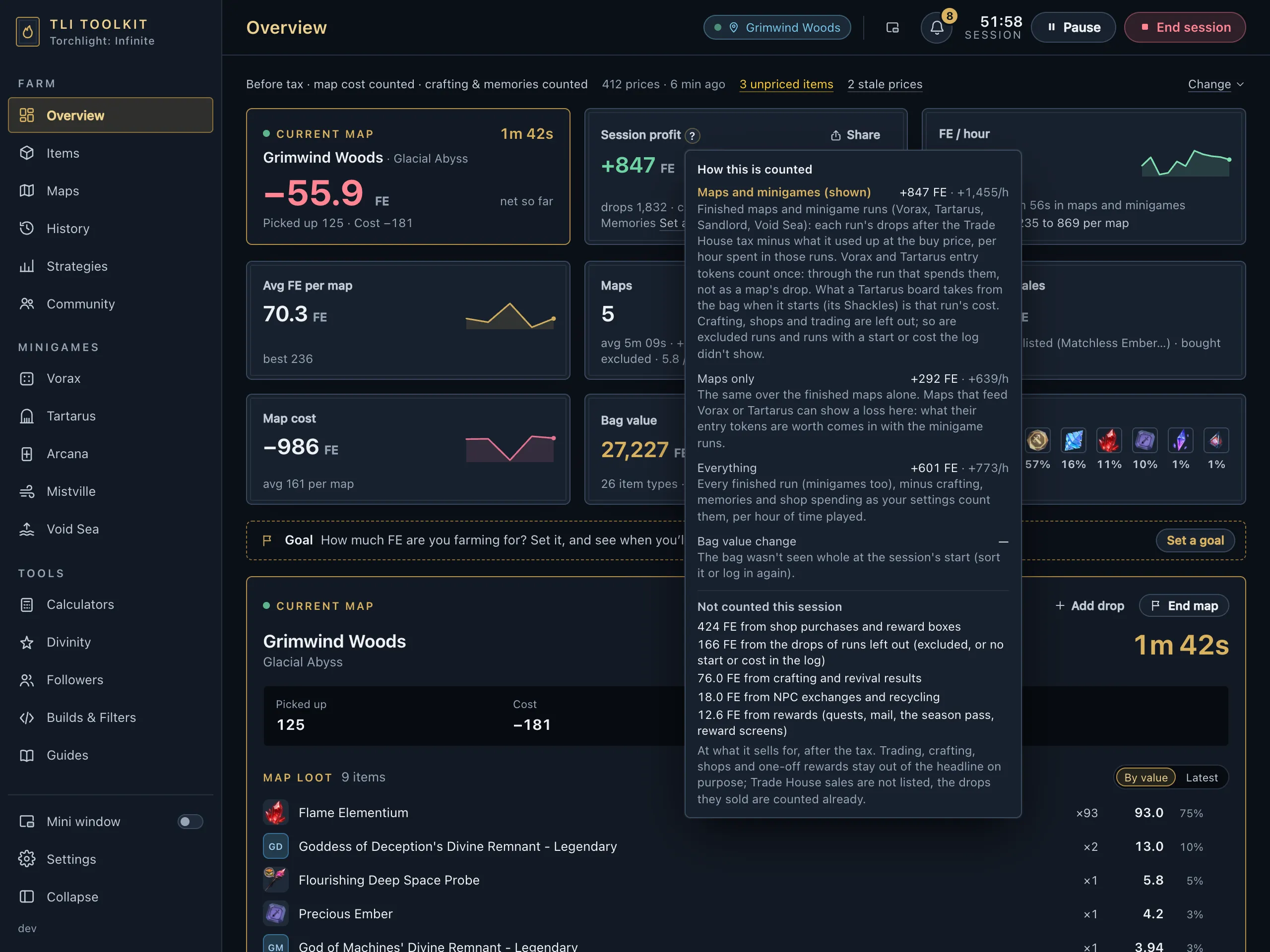
How this is counted — enlarged sample
- The tracker reads the game log: each map’s cost and drops, priced live, after tax when you want, per map and per real hour. No screen reading, nothing typed.
- History shows the middle run and the middle half next to the mean, in real time or in map, and you can leave an outlier (one lucky drop) out of every stat.
- Strategies compare your own setups by median net per map; Combined strategies count the minigames with the maps that paid for them.
- The mini window shows FE per hour while you play. What the tracker counts.
Free for Windows 10 and 11: download TLI Toolkit.
Items in this guide

Try it in the app
It’s part of TLI Toolkit, free for Windows 10 and 11.
FreeWindows 10/11, no installWhat’s new
TLI Toolkit is a Windows PC app: open tlitoolkit.com on your PC to download it. The guides and strategies work on any screen.
Written from the game’s own texts, patch notes and community research. Mechanics change between seasons; if something here is out of date, tell us on GitHub.