
Guide · SS14 Tartarus

Torchlight: Infinite Tartarus solver and prison guide
The free Tartarus solver compares moves on your current prison board. Use its Windows overlay to plan cell openings, Chromatic upgrades and the Riot.
Play around the Torture Instruments you picked ↓
Also called: Sandbox
Sandbox, Warden, Objectives, King of the Caged, Undercurrents
Last checked against SS14 Tartarus · 12 min read · updated
On this page
Play around the Torture Instruments you picked
Start with the instruments you already hold, not the cards still on offer. Read the current tooltip, identify the action that triggers it, then compare the immediate gain with the opportunities it spends. Recheck after each pick and each changed board.
Worked example: Replace cannot fix every mismatch
- At the current cellInvented board: you hold Iron Pestle, today’s Replace is available, and the current inmate has no legal meal. Another inmate could still use it as food later. Check the actual Code, rarity and targets before choosing.
- Compare ReplaceCompare Replace with ending the day. Pestle keeps the Code: a different rarity might create a meal, but rerolling does not change who this Code counters. Replace also spends the current inmate and its known value as future food.
- After the resultIf the cell has a Tusk mark, include its possible board-wide growth before deciding. After Replace, read the actual result and check legal actions again. If you end the day instead, preserve the future opportunity deliberately; neither line is always better.
Replace with Iron Pestle: what stays, what changes
Before Replace
1: A marks the current inmate’s Code; ◇ stands for its known rarity. Replace is available.
After Replace
1: A stays the same; ? means the new rarity is not known in advance. Read the result before choosing a meal.
Tartarus choices and tier list
Engine estimates from 40 seeded runs, with 8 paired futures per board. Gains use the Chromatics goal at the Riot and include a small credit for remaining inmate rarity. Research methods
Compare actions and picks · See combinations
Run instruments Boards 120
S
- Elephant-Foot Maul: Mammoth
- Iron Crown of the Prison King: Berserk Lion
- Kin's Coin of Fate
- Executioner's Blacklist
- Blood-Stained Trap: Berserk Lion
- Skewered Rat Heads: Colossal Rat
- Hangman's Noose


A
- Filthy Claws: Alpha Wolf
- Avenger's Casket
- Iron Tongs of Lust: Mammoth
- Rusty Saw
- Barbed Whip
- Ferocious Beast's Ravenous Chains


B
- Long-Chained Shackles
- Maddened Beast's Barbed Collar
- Crowded Beastcage
- Sorting Hook
- Fanged Guillotine: Alpha Wolf
- Lost Ring of Keys
- Severed Iron Maiden
- Raging Beast's Agonizing Muzzle
- Burning Stake
- Gaoler's Execution Axe
- Squirming Iron Box: Colossal Rat
- Felon's Dog Tag


C
- Searing Branding Iron
- Short-Chained Shackles
- Iron Pestle
- Warden's Scales
- Scapegoat's Guillotine
- Forged Key


Chromatic picks
- Three-Headed Thumb RingA
- Crimson VintageB
- Brass Horn of StrifeB
- Brand of Original SinC


Opulence first picksSmall sample · Boards 16
A Chromatic normally gives one pick. Opulence gives three from the same four cards, with repeats allowed. The first-pick test lets the policy choose the two remaining cards in both cases.
- Three-Headed Thumb RingA
- Brass Horn of StrifeB
- Crimson VintageC
- Brand of Original SinC
Replace or Consume versus End
- Mammoth · ReplaceASmall sample · Boards 19
- Mammoth · ConsumeB
- Alpha Wolf · ReplaceBSmall sample · Boards 28
- Berserk Lion · ReplaceBSmall sample · Boards 27
- Colossal Rat · ConsumeBSmall sample · Boards 39
- Berserk Lion · ConsumeB
- Colossal Rat · ReplaceCSmall sample · Boards 30
- Alpha Wolf · ConsumeCSmall sample · Boards 37
Visible inmates versus other offered destinations
- Alpha WolfBSmall sample · Boards 39
- Berserk LionCSmall sample · Boards 38
- Colossal RatCSmall sample · Boards 38
- MammothCSmall sample · Boards 37
Hunt versus End and Chain versus Stop
- HuntStrong in testing, but too few boards for a tierSmall sample · Boards 20
- ChainBSmall sample · Boards 38
Best tested run-instrument pairs
Two pairs lead on synergy and two on total gain. Synergy measures what the pair adds beyond the sum of its individual gains.
Skewered Rat Heads: Colossal Rat + Squirming Iron Box: Colossal Rat
SIron Box nests can mature into Rare Rats. Skewered Rat Heads lets a Rat eat another Rat of the same rarity and adds two tiers to the Consume gain.
Executioner's Blacklist + Gaoler's Execution Axe
SWhen Replace raises rarity, the Axe opens cells and can bring the number of sealed cells down to the Blacklist’s trigger range.
Elephant-Foot Maul: Mammoth + Kin's Coin of Fate
SThe Maul lets Mammoths eat higher-rarity prey they counter. The Coin can promote matching inmates when they share Code and rarity.
Elephant-Foot Maul: Mammoth + Hangman's Noose
SThe Noose produces Rare or better replacements. When one is legal prey, the Maul lets a Mammoth eat it even at higher rarity.
Best tested Opulence sequencesSmall sample · Boards 16
Crimson Vintage → Crimson Vintage
ABoth picks can promote inmates that are still below Legendary when each pick resolves.
Brass Horn of Strife → Brand of Original Sin
AThe Horn spends available Consumes first. The Brand can give some inmates left without prey a Code with a legal target.
Brass Horn of Strife → Brand of Original Sin → Brand of Original Sin
AAfter the Horn resolves available Consumes, each Brand pick can retarget inmates that still lack a meal if a new Code can find one.
Crimson Vintage → Crimson Vintage → Brand of Original Sin
ATwo Vintage picks can raise inmates below Legendary. The Brand can then look for Codes with legal prey at the resulting rarities.
The run instrument names and icons in the guide come from decoded game entries.
Which held instrument changes your next action?
Look up a held instrument
This qualitative lookup is inferred from TLI Toolkit’s rules model, not a ranking or a guarantee about the live game. Check the Objective, theme, remaining days, offered Destinations, legal actions and cell marks before using a row.
Iron Pestle
Replace preserves the inmate’s Code in this model. Recheck rarity and eligible meals afterward; do not expect a different counter relationship.
Scapegoat's Guillotine
Guillotine can sacrifice other inmates during Replace: include those losses. Axe can open cells when Replace raises rarity; a Replace alone does not guarantee that trigger.
Gaoler's Execution Axe
Guillotine can sacrifice other inmates during Replace: include those losses. Axe can open cells when Replace raises rarity; a Replace alone does not guarantee that trigger.
Warden's Scales
Scales can add scouting to Replace; information is not a promotion. Noose and Stake change replacement rarity outcomes; Stake also reduces Destination choices. Compare with a ready Consume before gambling.
Hangman's Noose
Scales can add scouting to Replace; information is not a promotion. Noose and Stake change replacement rarity outcomes; Stake also reduces Destination choices. Compare with a ready Consume before gambling.
Burning Stake
Scales can add scouting to Replace; information is not a promotion. Noose and Stake change replacement rarity outcomes; Stake also reduces Destination choices. Compare with a ready Consume before gambling.
Short-Chained Shackles
Compare the destination first, then movement length: short travel can open a cell, long travel can promote an inmate. Do not pass a useful immediate action solely for a random effect.
Long-Chained Shackles
Compare the destination first, then movement length: short travel can open a cell, long travel can promote an inmate. Do not pass a useful immediate action solely for a random effect.
Iron Tongs of Lust: Mammoth
With Tongs, inspect the Tusk-marked location before Replace and account for possible growth elsewhere. With Maul, recheck Mammoth’s higher-rarity prey; the counter relationship still matters. Do not assume a mark is a permanent inmate identity.
Elephant-Foot Maul: Mammoth
With Tongs, inspect the Tusk-marked location before Replace and account for possible growth elsewhere. With Maul, recheck Mammoth’s higher-rarity prey; the counter relationship still matters. Do not assume a mark is a permanent inmate identity.
Blood-Stained Trap: Berserk Lion
With Trap, inspect Hunt and its current targets separately from Consume. With Crown, recheck Lion’s equal-rarity targets under the widened rule. After growth, inspect the actual Code before planning another action.
Iron Crown of the Prison King: Berserk Lion
With Trap, inspect Hunt and its current targets separately from Consume. With Crown, recheck Lion’s equal-rarity targets under the widened rule. After growth, inspect the actual Code before planning another action.
Filthy Claws: Alpha Wolf
With Claws, inspect Scratch-marked unopened cells and their shown rarity as feeding candidates. Guillotine allows Wolf to take lower-rarity prey, but a legal bite need not raise rarity.
Fanged Guillotine: Alpha Wolf
With Claws, inspect Scratch-marked unopened cells and their shown rarity as feeding candidates. Guillotine allows Wolf to take lower-rarity prey, but a legal bite need not raise rarity.
Squirming Iron Box: Colossal Rat
With Iron Box, compare Rat Nest maturation with the time left; an unfinished nest is not an earned cache. Skewered Rat Heads opens Rat-on-Rat feeding possibilities; that exception does not apply to every Code.
Skewered Rat Heads: Colossal Rat
With Iron Box, compare Rat Nest maturation with the time left; an unfinished nest is not an earned cache. Skewered Rat Heads opens Rat-on-Rat feeding possibilities; that exception does not apply to every Code.
Before the Riot
Compare the caches already represented on the board with uncertain further growth. Count only effects that can still resolve before the run ends; recheck after every bite, opening or promotion. Cache-value presets express your preferences, not published loot prices. Exact Muzzle, Blacklist and Maiden counting examples are omitted because the model supports different rule interpretations.
Tartarus solver
Consume changes the ring
- Before
- After
First match the Warden’s position, day, theme, inmates, rarities, instruments, Objective and current screen. Enter the actual Destination cards when moving. A board alone does not tell the advisor which choices the game is offering or whether you already used today’s action.
Rare Mammoth + Rare Alpha Wolf → Legendary ? + closed cell
- Check legality. Mammoth counters Alpha Wolf and both are Rare. Under these conditions Consume is available. A Wolf of a different rarity would fail the ordinary rule.
- Compare what you give up. Consume takes a known upgrade; Replace discards the present Mammoth for a random inmate. This explains the immediate choice, without proving that Consume maximises the whole run.
- Consume in the game. The eater rises to Legendary, takes a new random Code and the Wolf’s cell closes. Read the result; do not keep the old Mammoth counter relationships.
- Check the next legal action. A Chain Consume requires a target for the new Code and rarity. If none exists, the example has no chain to perform. Resolve any reward or pending choice before treating the board as the next day.
Without a legal target, compare Replace with ending the day under your chosen goal. A small or awkward inmate is not automatically useless: replacing it can lose a known opportunity. The Objective and held instruments can change that comparison.
For the Windows app used in these checks, follow the Download and setup instructions, then compare the inputs with your game before using advice.
Tartarus solver: how a run works
Tartarus Prison is played on a ring of 16 cells, walked clockwise by you, the Warden. Cell 1 is the Interrogation Room, which never holds an Inmate. A run lasts 20 days (30 under the Iron Law theme) and ends in the Riot.
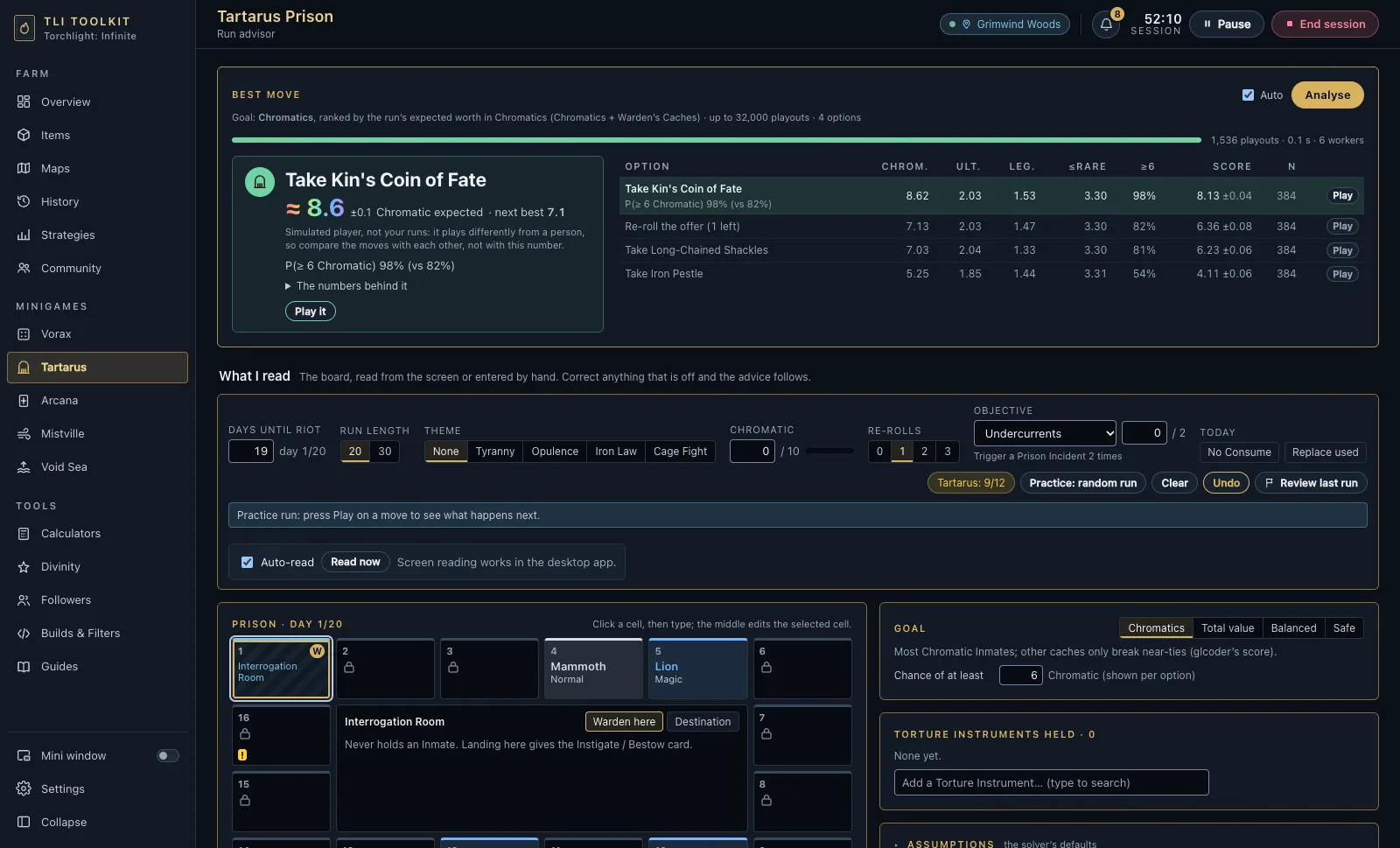
- Move. Each day you get up to three Destinations, drawn from the six cells ahead of you. Landing on an Unopened cell opens it and its Inmate comes out.
- Decide. Once a day the Inmate in your cell can Consume another, and before that you may Replace it once. Then end the day.
- Consume works on a countered Inmate of the same rarity. The eater rises one tier and takes a random new Code; the eaten one’s cell closes again. If the eater has another target, it can Chain Consume.
- Replace swaps the Inmate in your cell for a new random one: mostly Normal or Magic, now and then much better.
- An Inmate that reaches Chromatic leaves the board for the Chromatic panel (room for 10) and queues a Warden’s Treasure popup.
| Code | Counters |
|---|---|
| Mammoth | Berserk Lion, Alpha Wolf |
| Berserk Lion | Alpha Wolf, Colossal Rat |
| Alpha Wolf | Colossal Rat |
| Colossal Rat | Mammoth |
Rarities climb Normal → Magic → Rare → Legendary → Ultimate → Chromatic.
The other pieces
- Torture Instruments are lasting rule changes, offered three at a time (with re-rolls). The rare species instruments work for one Code and keep the other species’ ones out of later offers. A few cost you a daily Destination.
- Prison Incidents sit on cells as “!” markers and fire when you land there.
- The Interrogation Room offers Instigate (adds Prison Incident markers) or Bestow (a random Inmate rises a tier).
- Each run has an Objective and about one run in eight a theme (both below).
- At the Riot, every Chromatic you contained and every Inmate left on the board gives a Warden’s Cache of its rarity. Rarer caches drop better loot.
Objectives and themes
Every run draws one of five Objectives, shown at the top left of the prison board with its progress. Completing it brings a second Torture Instrument pick at once and an Ultimate or Chromatic Warden’s Cache at the Riot.
How the maths works
| Objective | To complete it | What counts |
|---|---|---|
| King of the Caged | Get an Inmate to Ultimate | Any Inmate reaching Ultimate, by Consume or Bestow |
| Survival of the Fittest | Consume 4 times | Every bite, chained bites included |
| Behind Cell Doors | Open 10 cells | Cells opened during the run (the start’s don’t count) |
| Undercurrents | Trigger a Prison Incident 2 times | Landing on a “!” cell; Instigate adds markers |
| Prison Walk | Move 18 tiles | The steps of your moves |
In the app’s simulated runs, four of the five are done by the Riot nearly every time; Undercurrents is the one that can fail, when the board runs short of “!” markers late in the run. That is when Instigate in the Interrogation Room is worth a day.
| Theme | What changes |
|---|---|
| Tyranny | Each stop in the Interrogation Room also Instigates and Bestows three times before you choose |
| Opulence | Three picks per Chromatic popup, with repeats allowed |
| Iron Law | 30 days instead of 20 |
| Cage Fight | An Inmate may also consume a countered Inmate of a lower rarity |
The Objectives’ targets are the game’s own; what counts toward them and the themes’ effects are as the app’s engine plays them, from the game’s texts and the community solvers’ logs. unconfirmed
What matters
- Chains make Chromatics. Rarity mostly rises one Consume at a time, so line up same-rarity pairs where one counters the other, and keep a chain going when the eater has another target.
- Replace is not a waste. A Normal or Magic Inmate with nothing to eat is usually worth swapping: in the app’s own test games the advisor chose Replace about half the times it was allowed.
- The Interrogation Room is a real option. The advisor takes it in roughly a third of the mornings it’s offered. Bestow raises a random Inmate a tier, which can turn an Ultimate into a Chromatic.
- Chase the Objective when it’s close: the second instrument and the extra cache are worth more than most single moves.
- Drop-quantity bonuses (compasses and Pactspirits) scale every cache alike, so they don’t change which move is best.
Treasure picks and the current board
You get up to two run-level picks: one at the start and one for completing the Objective. Each new Chromatic queues a separate popup with the same four cards. The run’s theme stays fixed. Normally you pick once per popup. Opulence gives three picks per popup and lets you pick the same card again.

Two Chromatics mean two popups in order: two picks normally or six under Opulence. In the solver model, the Three-Headed Thumb Ring opens up to three cells. With only one eligible closed cell, it opens at most one. Recheck the board after each pick before reusing your previous choice.
Owner-confirmed pick rules. Tartarus solver model for card effects.
When Treasure cards cover the prison
In TLI Toolkit beta.53, a Treasure offer can wait for a current view of the prison instead of ranking against an old board. Work through the prompt in order:
- With the Treasure cards visible, use Read now if the Toolkit asks to start the check. Use the eye in the game to show the prison, without choosing a reward.
- With Auto-read on, the eye action can start a read. If the prompt still asks for the prison, keep the cells visible, move the pointer off them and use Read now. A hidden-prison check needs game-window capture; follow the regular-prison-screen instruction if the source is unsuitable.
- Confirm only the missing details you know: today’s action state and theme when asked. “Used only Replace” and “Used Consume” are different states. Do not guess to unblock a ranking.
- Use the eye to reopen the same four cards. If the Toolkit still waits, use Read now with them visible. Confirm “same cards” only if you used the eye alone and took no other game action. Advice needs a fresh matching card read as well as the board check.
If a card was chosen, the offer changed, the board remains unclear or you are unsure of the missing details, follow the new prompt instead of reusing the previous confirmation. If the remaining Opulence picks are unknown, choose in the game and read the next regular prison screen as directed. A detected eye highlight is a cue to inspect the current screen, not proof that every layout will be recognised.
Sources: the app’s Tartarus legality/Consume rules and beta.53 recovery controls, checked 15 November 2026. The worked board is synthetic. Cache values remain goal assumptions, explained in the rewards guide.
How TLI Toolkit helps
Want help comparing the whole board? Download TLI Toolkit for board-specific Tartarus advice. Check its inputs against your game before following a recommendation.
- Select the screen you are actually using: Destinations, decision, Consume target, instrument or Treasure. Each has different legal options.
- Choose Chromatics, Total cache value, Balanced or Safe deliberately. Read predicted cache counts and the runner-up when the result is a close call.
- After moving or consuming, check the new board, remaining choices and Objective before the next action. Confirm only fields you can verify in the game.
Continue with the reward guide.
For Letters of Introduction and choosing a follower, follow the Followers guide.
Manual guidance checked 18 November 2026 against our rules model. These sources establish model behavior, not current tooltip accuracy, capture accuracy or guaranteed rewards. Legal actions and transitions; Rule assumptions; Instrument names and groups.
Get the Tartarus advisor
It’s part of TLI Toolkit, free for Windows 10 and 11.
FreeWindows 10/11, no installWhat’s new
TLI Toolkit is a Windows PC app: open tlitoolkit.com on your PC to download it. The guides and strategies work on any screen.
Written from the game’s own texts, patch notes and community research. Mechanics change between seasons; if something here is out of date, tell us on GitHub.